Mora Automation and Robotics AB (MARAB) in Mora has been helping companies automate their operations since 1999. A robot can streamline operations and replace monotonous and dangerous tasks, but customers need support and the right information from an experienced supplier to ensure they get the optimal solution and a sound overall cost analysis before making the investment. That’s what MARAB provides.
A project begins with drawing up the facility to determine how to make it as good as possible and to be able to present it to the customer. The starting point is sometimes a 2D drawing of the existing workshop layout. The proposal must then be able to be modified quickly when the customer presents new requirements, and ultimately, the same tools should suffice all the way through to the detailed drawings.
MARAB has been using IRONCAD for many years, for everything from initial layouts and customer discussions to detailed drawings. The customer’s 2D drawing is imported as a reference into the 3D environment, and all or parts of previous robot cells are quickly placed using drag-and-drop from catalogs on the side of the screen. The customer gets a clear picture of the solution, and the proposal is easy to modify.
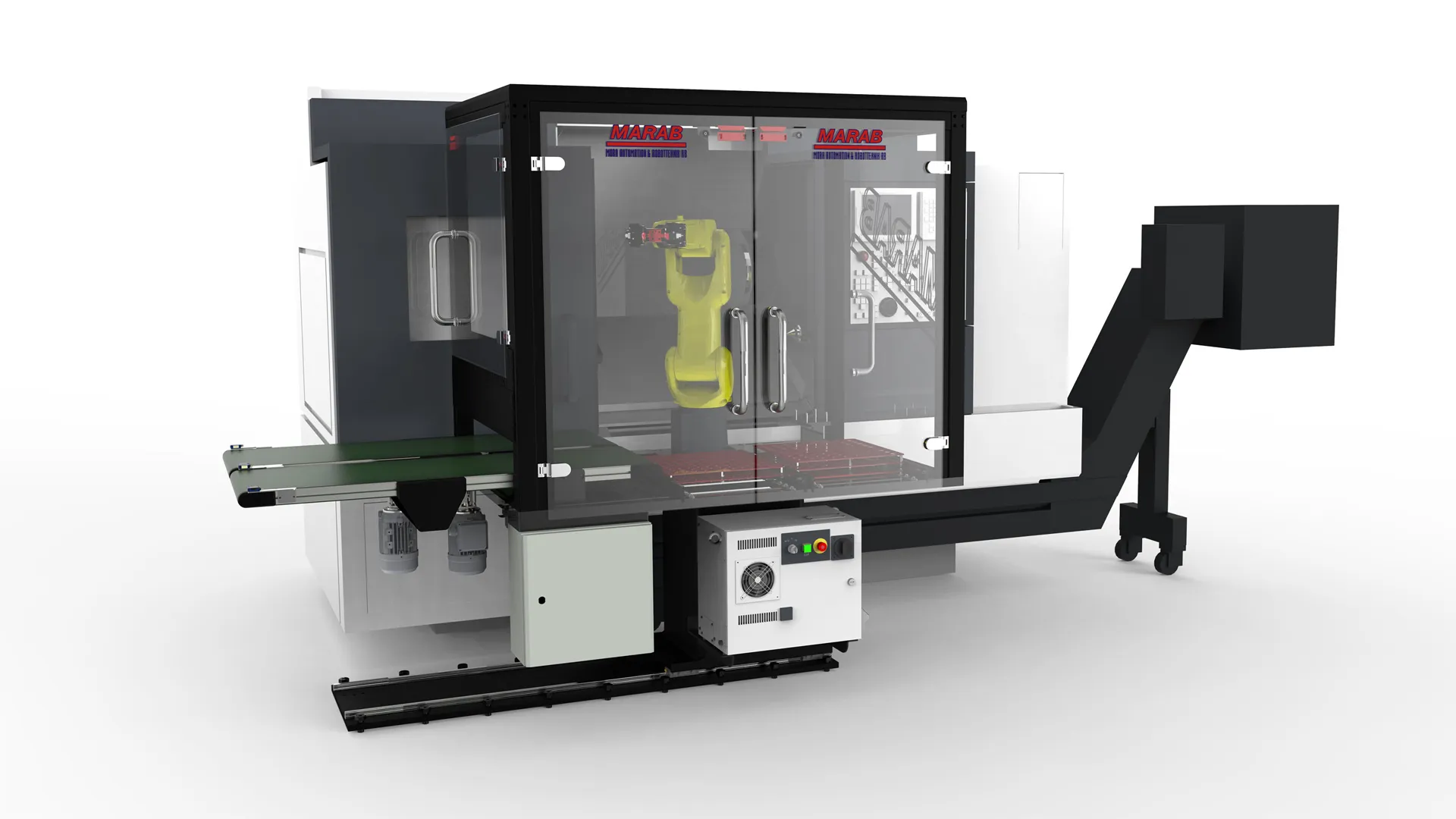
One area where MARAB has been particularly successful is machine tending, with a product line of standardized robotic cells. A milling machine is continuously supplied with new workpieces while machined parts are removed. The robot retrieves parts from a pallet or a conveyor belt, and a vision system identifies the incoming parts and their orientation. With both a pallet and a conveyor belt, the machine can operate unmanned for long periods of time.
MARAB can present customers with a clear solution early on, adapt it immediately to meet new requirements, and reuse proven cells in new facilities. The same tool is used throughout the entire process, from the quote layout to the manufacturing documentation.
We’ve been using IRONCAD for several years now, and it’s worked really well. Within the same 3D environment, entire robot cells or parts of previously created ones can be quickly placed using drag-and-drop from catalogs on the side of the screen. The customer gets a clear picture of what our solution looks like, and a very important feature is that we can easily modify a proposal to meet customer requirements.
Matilda Bastman, CEO, Project Management and Sales, MARAB