Looks like you don't have ESC button on your device
Choose one of the following options
trial versionHas a license

Looks like you don't have ESC button on your device
Choose one of the following options
trial versionHas a license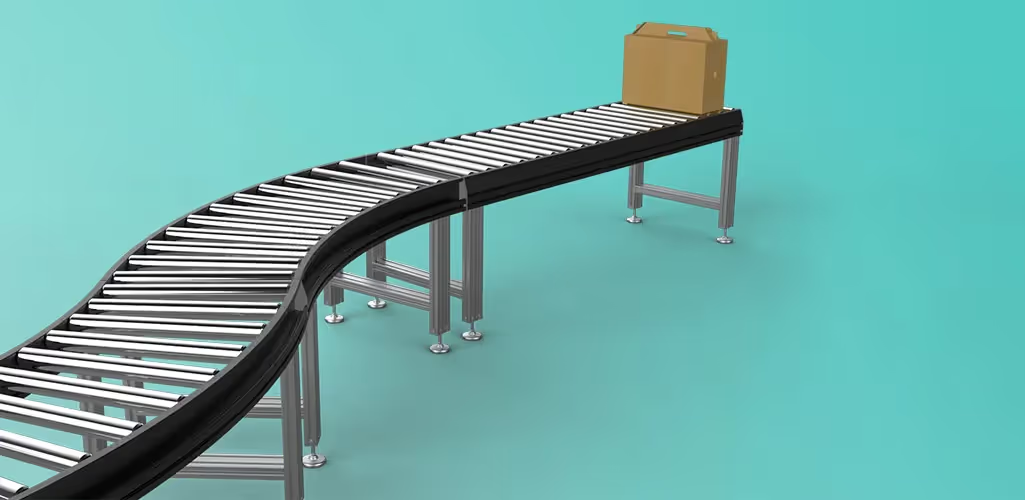

Emil Rindell

Jonas Bryntesson

Henrik Andersson
2021-04-08
Emil Rindell
Jonas Bryntesson
Henrik Andersson
2021-04-08
In some cases, you may need to visualize how an object moves in a given trajectory. In IRONCAD we have a whole catalogue of pre-made animation motions, but in some cases you can have your own 2D profile or 3D curve that the object should follow. In the post we'll go through how to do just that.
In this case, we will animate a box that will follow the transport path. Since the box will only move in the X-Y direction, it is sufficient to create a 2D profile. Go to the Sketch>2D-Shape tab and create your curve. We will then project off the edge of the conveyor and offset the curve so that it is centered in the conveyor. Next, the curve will be trimmed to create a start and stop point. If you are not sure how to do this, you can watch this clip:
To create the animation, we first go to the Visualization tab. Then select your part or assembly and press Add New Path. Under Motion Type, select Custom followed by Motion time where you enter the number of seconds for the animation. Then press Apply. Now you will see a grid, which is the grid for your animation. Here you now select Select Path and then click on the 2D profile. Now deselect the animation path by clicking anywhere in the Scene background. Then press On followed by Play. Watch this clip:
In this case, we also want the box to turn perpendicularly along the curve. This can be achieved by changing a setting for the animation. First select your batch or assembly that is animated. Then click on the animation curve to get back to the grid. Now right-click on the grid and select Animation Path Properties. Under Orientation At Type, change to Along Path followed by Ok. Then press On and Play.
It is also possible to create an animation along a 3D curve and the principle is exactly as above only the difference is that you choose the 3D curve instead of the 2D profile. In this movie, we use a robot that is defined with locks, which means that we also get a mechanical movement in our animation. Locks are thus not a requirement for making the animation along a 3D curve. Here we use an edge on an existing part and generate our guide curve from this. You do this by selecting the edge (highlighted in green) hold down Shift to select several lines, then right-click on a line and select Create>3D-Curve. Watch the movie below:
If you want to learn more about how Animations and IRONCAD work together, check out this film on IronCAD Academy:
Watch a movie about animation in IRONCAD

Answer: Here we publish tips, guides, news and solutions for those who work with IRONCAD and Design Data Manager (DDM). The blog covers everything from basic functions to advanced workflows, helping you to optimize your design work. You'll find examples of smart shortcuts, practical instructions, solutions to common problems, and best practices for product design, mechanical design, and product data management.
Answer: Our guides and tips are designed for both beginners and experienced CAD users. They are aimed at designers, engineers and project managers who want to work more efficiently with IRONCAD and DDM, improve the design process, reduce mistakes and save time in product development.
Answer: We regularly publish new articles when the software is updated, when new features are introduced, or when our users ask for solutions to specific problems. The blog is therefore a reliable source for keeping up to date and getting tips that make everyday CAD work easier.
Answer: Many of our instructions and tips work in multiple versions, but we clearly indicate if an article applies to a specific version. We strive to make the content useful for older versions as well, and also provide recommendations on how to adapt workflows to the version you are using.
Answer: Absolutely! If you can't find the solution in the blog, you can contact our technical support via solidmakarna.support. Our experts will help you with everything from installation and configuration to advanced features in IRONCAD and DDM, so you can solve problems quickly and efficiently.
Answer: Yes! We appreciate suggestions from our users. If you have questions, tips or want us to address a specific issue in IRONCAD or DDM , please contact us via our contact form and we will prioritize relevant topics in future posts.
Answer: The blog contains, among other things:
Practical step-by-step guides to help you use IRONCAD and DDM more effectively.
Productivity and workflow tips for faster design and construction.
Solutions to common problems encountered by users in CAD programs.
Updates and news on new features, versions and improvements.
Best practices for data management and project organization in DDM.
Answer: All tips and guides are directly applicable in daily work. For example, you can use shortcuts and smart features in IRONCAD to speed up modeling, structure files better in Design Data Manager, or follow our step-by-step solutions for specific problems that often come up in design projects.
Answer: We strive to ensure that all guides and tips are relevant to the latest versions of IRONCAD and DDM. We also clearly mark when a post applies to an older version, so you always know if the instruction is directly applicable to your system.
Answer: Yes! Many of our users share the articles with colleagues and use them as internal training materials. The blog is a great complement to formal training and helps teams learn features faster, avoid mistakes, and standardize workflows in IRONCAD and DDM.