Looks like you don't have ESC button on your device
Download IronCAD DCS
Choose one of the following options
trial versionHas a license

Looks like you don't have ESC button on your device
Choose one of the following options
trial versionHas a license

Emil Rindell

Jonas Bryntesson

Henrik Andersson
February 5, 2026
Emil Rindell
Jonas Bryntesson
Henrik Andersson
February 5, 2026
With IRONCAD, you can combine several different ways to move objects in the 3D scene. To help you get a handle on the various options, we’ve broken them down into different “levels of control” that you can use to manage this.
Follow these steps to switch from "unlocked" to "locked":
Fast and free, but without a clear idea of exactly where you'll end up—not recommended.
Use the mouse pointer to move an object freely in 3D space.
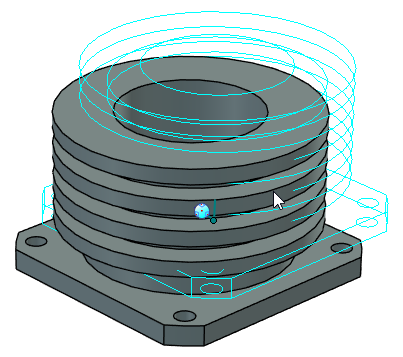
The object is still controlled by the coordinate system and occupies an "exact position," but the freedom afforded by the mouse pointer makes it virtually impossible to land "exactly" on a specific position. Perfect when you need to quickly and easily move objects in an early concept phase or when a specific object doesn’t need to be placed exactly, e.g., in a layout or interior design of a room with a chair standing somewhere on the floor. Can be combined with constraints to limit the degree of freedom.
The default mode in IRONCAD - fast and easy!
Use the TriBall to place (and/or rotate) one or more objects exactly where they need to be.
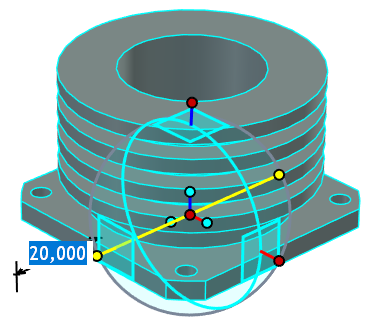
NOTE: This never creates any relationship or association with any other object in the 3D scene. This can also be combined with constraints to limit the degree of freedom.
Make certain steps clearer by including visible measurements.
Place one or more Smart Dimension measurements to check the position using a numerical value displayed on the screen.
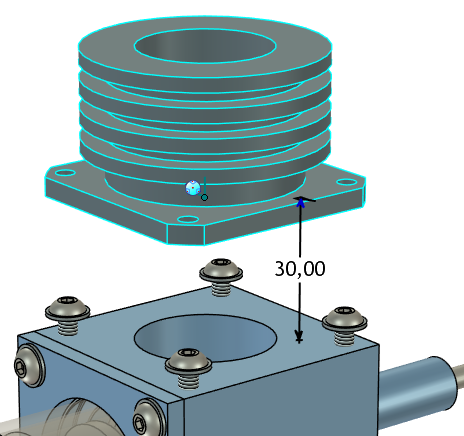
Since the measurement can be either "open" or "locked," you achieve different levels of control. A locked linear or angular dimension does not provide greater precision but merely adds the "restriction" function in its direction/angle. You can also choose to place linear dimensions relative to the Anchor Point (the origin of the local coordinate system) instead of geometric surfaces/edges/points.
Requires a lot of time and planning; rarely or never needs to be used in IRONCAD.
Control the position of objects in the 3D scene by applying constraints to other objects or to the coordinate system.
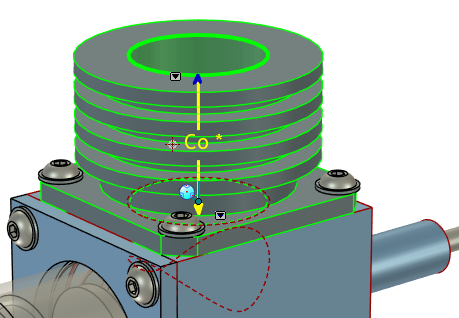
This can be combined with "full freedom" or TriBall/dimensions. This means that objects that are not "fully defined" by constraints therefore have a "degree of freedom" to be moved (freely) in any direction or rotated (freely) around an axis.
Most often used for a "base object" that other objects are locked to.
Lock an object completely so that it cannot be moved in any way using the "Fixed in Parent" setting.
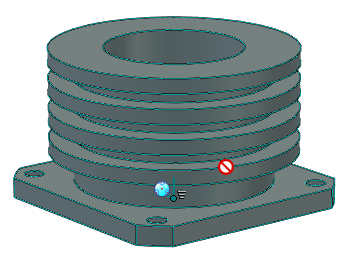
This locks an object in place within the coordinate system. No tool or setting can alter this position until you turn off the "Fixed in Parent " function on the selected object again. It is most often used in combination with constraints, since you need a stable and locked starting point for movements using, for example, Mechanism Mode.

Answer: Here we publish tips, guides, news and solutions for those who work with IRONCAD and Design Data Manager (DDM). The blog covers everything from basic functions to advanced workflows, helping you to optimize your design work. You'll find examples of smart shortcuts, practical instructions, solutions to common problems, and best practices for product design, mechanical design, and product data management.
Answer: Our guides and tips are designed for both beginners and experienced CAD users. They are aimed at designers, engineers and project managers who want to work more efficiently with IRONCAD and DDM, improve the design process, reduce mistakes and save time in product development.
Answer: We regularly publish new articles when the software is updated, when new features are introduced, or when our users ask for solutions to specific problems. The blog is therefore a reliable source for keeping up to date and getting tips that make everyday CAD work easier.
Answer: Many of our instructions and tips work in multiple versions, but we clearly indicate if an article applies to a specific version. We strive to make the content useful for older versions as well, and also provide recommendations on how to adapt workflows to the version you are using.
Answer: Absolutely! If you can't find the solution in the blog, you can contact our technical support via solidmakarna.support. Our experts will help you with everything from installation and configuration to advanced features in IRONCAD and DDM, so you can solve problems quickly and efficiently.
Answer: Yes! We appreciate suggestions from our users. If you have questions, tips or want us to address a specific issue in IRONCAD or DDM , please contact us via our contact form and we will prioritize relevant topics in future posts.
Answer: The blog contains, among other things:
Practical step-by-step guides to help you use IRONCAD and DDM more effectively.
Productivity and workflow tips for faster design and construction.
Solutions to common problems encountered by users in CAD programs.
Updates and news on new features, versions and improvements.
Best practices for data management and project organization in DDM.
Answer: All tips and guides are directly applicable in daily work. For example, you can use shortcuts and smart features in IRONCAD to speed up modeling, structure files better in Design Data Manager, or follow our step-by-step solutions for specific problems that often come up in design projects.
Answer: We strive to ensure that all guides and tips are relevant to the latest versions of IRONCAD and DDM. We also clearly mark when a post applies to an older version, so you always know if the instruction is directly applicable to your system.
Answer: Yes! Many of our users share the articles with colleagues and use them as internal training materials. The blog is a great complement to formal training and helps teams learn features faster, avoid mistakes, and standardize workflows in IRONCAD and DDM.